المشاركات

Poem Analysis: I Wandered Lonely as a Cloud by William Wordsworth

صورة
📝 Introduction I Wandered Lonely as a Cloud by William Wordsworth is a popular poem in English Romantic literature, having been first published in 1807. The poem, which was originally inspired by a hike he had with his sister in the Lake District near Ullswater, captures the core ideas of Romanticism: emotional meditation, nature, remembrance, and solitude. Its straightforward language and profound emotional impact continue to make it a popular study topic today. 📖 Summary of the Poem The speaker compares loneliness to a straying cloud. He comes upon a field of golden daffodils "fluttering and dancing in the breeze" next to a lake while out for a stroll. He is deeply affected emotionally by the scene's beauty. The memory comes back to him later when he is by himself and reflecting, and it makes him happy and makes his heart "dance with the daffodils." 🌱 Major Themes 1. Nature as a Joyful Source According to Wordsworth, nature is a source of inspiration an...
Interpretation of the Conflicts of Mortality and Desire in Keats’ ‘Odes'

صورة
Desire and Mortality in the Odes of John Keats John Keats, one of the greatest English Romantic poets, is often celebrated as the “poet of beauty.”  Keats explores the themes of desire, mortality, art, and the fleeting nature of life in depth in his well-known odes, "Ode to a Nightingale," "Ode on a Grecian Urn," and "To Autumn." Along with praising beauty and the natural world, these lyrical poems also consider death, an inevitable aspect of life. The Conflict Between Desire and Mortality in “Ode to a Nightingale” In "Ode to a Nightingale," the speaker longs to escape the hardships and tribulations of human existence after being mesmerized by the nightingale's mesmerizing song. He imagines sipping wine while standing in a pitch-black forest and vanishing into the tranquil, timeless realm of the bird. He enters a dreamlike trance where death seems pleasant and painless because he wants to forget about his problems in this world. Neverthel...

Reality vs Appearance in the story Luncheon by William Somerset Maugham

صورة
Appearance vs. Reality: A Deep Dive into W. Somerset Maugham’s “The Luncheon” The well-known English author William Somerset Maugham examines the theme of appearance vs. reality in his short story "The Luncheon," showing how things can appear one way on the surface but be completely different on the inside. Maugham uses wit and irony to highlight the social intricacies and the fallaciousness of appearances in interpersonal relationships. Premise of the Story The narrator of “The Luncheon” is a young and struggling writer. He tells the story of a woman who says she loves his writing and contacts him, saying she would really like to meet him. The young writer is flattered by her praise and consents to meet her at Foyot's, a classy Parisian restaurant renowned for its pricey menu and opulent ambiance. The young writer agrees to meet the woman despite knowing that Foyot's is well beyond his means, in part out of politeness and in part out of vanity. The lady appeared pol...

The absurd Class Consciousness in Mansfield's The Garden Party

صورة
Laura’s Epiphany and Class Distinction in “The Garden Party” by Katherine Mansfield The Garden Party , a gripping short story by Katherine Mansfield, examines human empathy, class distinction, and the brittle lines separating privilege and poverty. The story offers a powerful critique of how social class influences people's behavior, values, and emotional comprehension. It is told from the viewpoint of Laura Sheridan, the youngest child in an upper-class family. The Garden Party and the Death Next Door The Sheridan family is getting ready to throw a lavish garden party. As the family is busy getting ready, a tragic incident interrupts the morning: Mr. Scott, a working-class neighbor, unexpectedly passed away in an accident, leaving behind a wife and five children. The news deeply disturbs Laura, who is compassionate and sensitive. According to her, it would be rude and inconsiderate to the family who are grieving next door if the party went on. However, her concern is dismisse...

The key points of Magna Carta and the importance of the Great Charter in England

صورة
Magna Carta, or the Great Charter, is the most important constitutional document in the history of England. It was drawn up by the barons who forced King John to sign the document in 1215 AD. It had sixty-three clauses from which we can infer the nature and extent of King John's misdeeds. Magna Carta was a remedial document to the nation against the oppressive nature of John. The main purpose of the Great Charter was to establish equal rights and privileges for society. The Great Charter declared that the king could not rule as he pleased and had to abide by the law. It had established crucial clauses, such as the prohibition against selling, denying, or delaying justice to anyone, and the prohibition against any freeman being imprisoned or punished without the proper judgment of his peers or the law. Personal liberties had been protected and guaranteed. Additionally, the church's autonomy to set up elections for bishoprics had been guaranteed. The tax demands made by King ...

The use of imagery in Wordsworth's "Lines Composed a Few Miles Above Tintern Abbey" and "Ode: Intimations of Immortality from Recollections of Early Childhood."

صورة
Imagery in “Tintern Abbey” and “Ode: Intimations of Immortality” by William Wordsworth William Wordsworth, a leading figure in English Romantic poetry, is renowned for his introspection, spiritual development, and memory. He also had a close relationship with nature. These themes are exquisitely captured by the deft use of imagery in two of his best-known poems, "Lines Composed a Few Miles Above Tintern Abbey" and "Ode: Intimations of Immortality from Recollections of Early Childhood." The main theme of these two poems is the impact of nature on the human spirit and memory, despite their different tones and structures. Wordsworth immerses the reader in his world and emotional state in both pieces by creating vivid mental images. Imagery in “Tintern Abbey” Wordsworth reflects on his return to the banks of the River Wye after a five-year absence in his intensely personal poem Tintern Abbey. The poet describes how, despite being physically away, the scenery and ...

A Discussion on "The Rime of the Ancient Mariner" as an allegory of crime, punishment and redemption

صورة
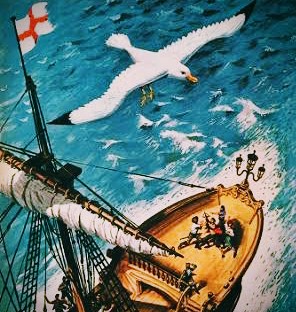
“The Rime of the Ancient Mariner” by Samuel Taylor Coleridge— An Allegory of Crime, Punishment, and Redemption Samuel Taylor Coleridge, one of the greatest Romantic poets in English literature, wrote the amazing and profoundly symbolic poem "The Rime of the Ancient Mariner."  Coleridge's skillful use of supernaturalism to examine weighty moral and philosophical concepts is what sets him apart. The mariner's journey turns into a spiritual journey in this lengthy narrative poem, which tells a symbolic story of crime, punishment, and redemption in the end. The Crime: Killing the Albatross The poem's central error is the ancient mariner's murder of the defenseless albatross, a bird that represents hope and the natural world. The bird appears while the mariner and his crew are at sea, and the awful storm quickly gives way to a favorable wind. The bird is viewed as a blessing by everyone on board. Nevertheless, the mariner commits an illogical and careless crime a...